
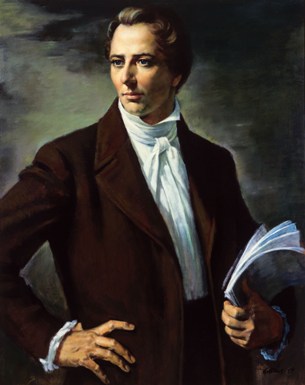
 Joseph Smith was a young farm boy of fourteen in 1820, when New England was experiencing a religious revival along with a lot of religious confusion. Joseph was trying to figure out which of the many churches he should join, but he was very confused. He went to one church and then to another and couldn’t pick out anything that showed one church as true and one church not true. He went to the scriptures and found his answer in James 1:5: “If any of you lack wisdom, let him ask of God, that giveth to all men liberally, and upbraideth not; and it shall be given him.” The answer the scriptures gave him was to ask of God, so he decided to do exactly that.
Joseph sought out a quiet grove of trees near his home to pray. He asked God which church he should join. The answer was glorious: Joseph’s first vision came unexpected and bright. In his history, he described it: “When the light rested upon me I saw two Personages, whose brightness and glory defy all description, standing above me in the air. One of them spake unto me, calling me by name and said, pointing to the other—This is My Beloved Son. Hear Him!” God, the Father, and Jesus Christ appeared to Joseph Smith and personally told him that none of the churches were true and that he shouldn’t join any of them.
This First Vision was the first of many. However, Joseph was still very young and he needed more teaching and preparation before restoring God’s true Church and the fullness of the gospel of Jesus Christ. Even at the beginning his vision was largely rejected because most people believed (and still do) that God doesn’t speak to man directly any more and that the time for visions passed long ago. Despite rejection, and ultimately martyrdom, Joseph would not deny what he knew to be true.
When Joseph was seventeen, he had another vision. An angel Moroni appeared to him and told him about an ancient record kept on gold plates, written by a people who had once lived on the American continents. This people was brought out of Jerusalem in 600 B.C. by the hand of God, before the city was destroyed. The record tells of Christ’s dealings with this people and contains the fullness of His gospel.
When Joseph was finally ready, Moroni, who was the last man to write in the record, led Joseph Smith to find it where he had buried it hundreds of years before. Joseph translated this record by the power of God and published it as the Book of Mormon. This book is another testament of Jesus Christ and bears record of His visit to the Americas after His resurrection. The Book of Mormon restored truths about Christ and portions of His gospel that had been lost from the Bible over two thousand years.
The Book of Mormon might be Mormonism’s most famous aspect, but it wasn’t all that Joseph Smith restored. Through him, the Lord also restored the priesthood, which is the authority to act in God’s name. Joseph Smith received a visit from John the Baptist and was given the Aaronic Priesthood (which lets holders preach and baptize with God’s authority). Then he was visited by Peter, James, and John, Christ’s apostles, who gave him the Melchizedek priesthood (which gives the holder authority to give the gift of the Holy Ghost, among other ordinances). The priesthood was lost from the earth after Christ’s apostles were killed; thus so was the authority to act in God’s name. Now that the priesthood is restored, it will never again be lost from the earth. All worthy male members of The Church of Jesus Christ of Latter-day Saints (the official name of the Mormon Church) who are of age may hold the priesthood, and each can trace their priesthood line directly back to Jesus Christ.
On April 6, 1830, Joseph Smith organized The Church of Jesus Christ of Latter-day Saints. The Church had only six members at first, but grew rapidly and today has more than 13 million members. Joseph Smith received revelations continually throughout the rest of his life, as each prophet after his has continued to do. The gospel has been restored. It has continued to grow in the generations since Joseph Smith’s martyrdom, and is larger than ever today. It stands firm as the one true church on earth.