
Overview
The Church of Christ was organized on April 6, 1830, in Fayette, New York. (The now-official name, The Church of Jesus Christ of Latter-day Saints, came to Joseph Smith by revelation in 1838. The term “Mormon Church” is just a nickname.) At that time the Church was organized, there were six members, and most of them were Joseph’s friends or family, but membership grew quickly. Unfortunately, so did persecution. In those early days, the Mormons moved their main body pretty frequently—to accommodate that growth and escape that persecution. They moved from New York to Kirtland, Ohio—then to western Missouri, then to Illinois, and finally to Utah.
The Mormons were never driven from Utah, although their time there wasn’t exactly peaceful, and there the Church headquarters remain. Official persecution (for some persecution came from the United States government) stopped at the end of the nineteenth century. The Church expanded yet more and the faith spread well beyond Utah and even the United States. Today, the Church spans the world, and most Mormons live outside the United States.
This is an outline of the history of Mormonism from 1820 to the present. The links in the headings go to pages that give a much more complete treatment of the time period.
Outline of Mormon History
New York Period
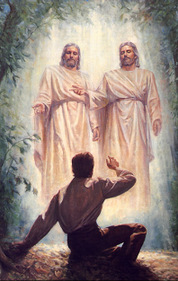 Joseph Smith, Jr. received his First Vision when only 14 years of age. Jesus Christ and God the Father appeared to him. Later, the Angel Moroni appeared to him and directed him to find a record on golden plates. Joseph Smith translated and published this record as the Book of Mormon. In 1830, he organized the Church of Christ, or the Mormon Church. Quickly after the Church’s founding, missionaries were sent to preach this revealed and complete gospel. Persecution also grew quickly.
The main gathering place of the Mormons moved to Kirtland, Ohio. The Lord revealed many things to Joseph Smith. Other Mormons hoped to build Zion and moved to Missouri. The first Mormon temple was built in Kirtland. Joseph began a translation of the Book of Abraham from papyri obtained from Egypt. He published the Doctrine and Covenants. Canada and England were visited by missionaries. The Quorum of the Twelve Apostles was established. Mormons in Missouri were persecuted and Joseph Smith organized and launched Zion’s Camp to protect them. The main bulk of the Church moved to Missouri in 1838.
The first part of Missouri which Mormons settled was Jackson County—they settled there in 1831. They were driven from that county in 1833 by mobs. Temporarily, Clay County was the site of Mormon settlement—more permanent settlements were in Caldwell and Davies counties in 1836. There, too, they were harassed by mobs. Some Mormons fought back, among them the Danites. When the whole Church moved to Missouri, the conflict got worse. Joseph Smith and other leaders were arrested, then kept imprisoned for several months without trial. Mormons were forced out of Missouri with the Extermination Order. Dozens of Mormons were massacred at Haun’s Mill, and others were burned out of their homes. They fled to Illinois, led by Brigham Young.
Nauvoo and the Martyrdom
Mormons founded Nauvoo, Illinois, which, in a few years, rivaled contemporary Chicago in size. In Europe, Mormon missionaries had some success, particularly in England and Scandinavia. Saints began work on the Nauvoo Temple. The Church was still persecuted, and Joseph Smith often hid himself from enemies. However, he still had revelations on subjects like plural marriage (called, sometimes, Mormon polygamy), eternal marriage, baptism for the dead, and the plan of salvation. In June 1844, Joseph and Hyrum Smith were murdered. The Twelve Apostles stepped up to lead the Church. The Nauvoo Temple was completed in time for the Mormons to be driven out that very year.
Mormons were scattered throughout Iowa. The Mormon Trail to Utah was established and the Church proceeded accordingly. The Mormon Battalion participated in the U.S.–Mexican War and also explored California. Utah was settled by Mormon pioneers who also established cities in Colorado, Arizona, Wyoming, Nevada, Idaho, southern Canada, and northern Mexico. This was a ten-year period of peace for the Mormon Church. The Church sustained Brigham Young as its Church President and Prophet.
Through lies and political pressure, former Utah officials persuaded President James Buchanan that Utah was in rebellion. Johnston’s Army was sent out to suppress the rebellion. The States dismissed Brigham Young as governor of Utah, but didn’t actually tell him so. The Mormons were afraid of being driven out again, so they scattered army horses and burnt swatches of grass. However, the army concluded Utah was innocent of rebellion and peace was established. Unfortunately, before this, fears of invasion got to such a high point that some Mormons massacred a group of settlers bound for California in the Mountain Meadows Massacre.
Post-Civil War Persecution
During the Civil War, the Mormon Church was left in peace again. The Mormon missionary work continued in Europe and also in Asia, Mexico, and South America. After the Civil War, Congress passed several anti-polygamy laws, and thousands of Mormons were ultimately jailed. Others weren’t allowed to vote or hold office or even own property. To keep Mormons out of work, loyalty oaths were instituted. Church leaders went into hiding and many Mormons ran to Canada and Mexico. However, the practice of Mormon polygamy ceased after the Church President and Prophet Wilford Woodruff received a revelation from the Lord discontinuing it. U.S. President Grover Cleveland later pardoned all polygamists who enetered marriages before anti-polygamy laws were passed. Thousands of European Mormons came to Utah.

In the next few decades of Mormon history, peace reigned. Although the Church ran up large debts during persecution (which would yet take more time to pay off), prosperity returned to it. Apostle Reed Smoot was elected to the U.S. Senate and had to fight for two years to be allowed to take his seat. The Lord revealed an important revelation about baptism for the dead to Church President Joseph F. Smith. The Church celebrated its centennial and started to buy historical sites. During the Great Depression, the Church Welfare System was created for the sake of needy members.
Mormons stopped moving to Utah enmasse—most were encouraged to remain where they were and build up the Church in their home countries. The missionary work in the Pacific Islands and South America led to thousands of converts. Mormon temples were built in Europe, Hawaii, Europe, New Zealand, and Canada. Mormons were on both sides of World War II, and many were trapped behind the Iron Curtain after the war.
International Growth
After World War II, the Mormon Church grew exponentially, and so did the number of temples. A temple was even built in Soviet-controlled East Germany. The widest-traveled Mormon President to that date was President David O. McKay. The Mormon welfare programs, and those programs for humanitarian work, expanded and gave valuable aid to the reconstruction of Japan and Europe. Missionary training centers were established to help missionaries learn the many languages of those they preached to. All members were encouraged to be missionaries by David O. McKay, and one of his successors, Spencer W. Kimball, received a revelation that all male members should serve missions. The missionary force grew to 50,000 and beyond. The Church’s government and programs were streamlined through the correlation program due to the Church’s massive growth. The growing Church in Africa and Brazil prompted Spencer W. Kimball to pray about priesthood and how it was not given to Blacks. He received a revelation in 1978 that the priesthood could be given to all worthy male members, and Church growth in Brazil and Africa became exponential. The Church focused on translating the Book of Mormon into dozens of languages in the 1980s, and Mormons answered the call to “flood the earth” with it.
Contemporary Developments
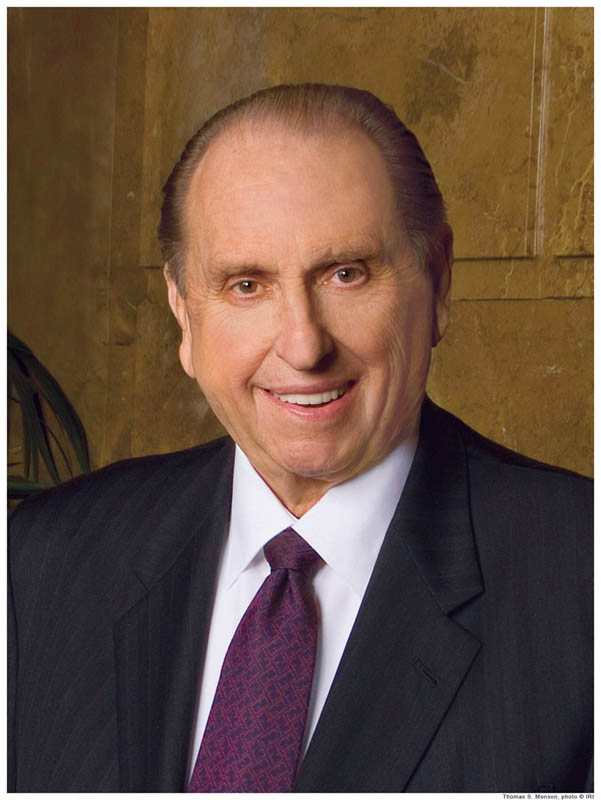 Since the early 1990s, the Mormon Church has grown past 13 million members. South America and Africa are some of the primary sources of the growth, as are nations of the former Soviet Union, particularly Russia. Since the late 1990s, the majority of Mormons now live outside the U.S. The Church builds hundreds of new meetinghouses every year. In 1995, Gordon B. Hinckley became President of the Church and became the most widely traveled president to date. The First Presidency issued The Family: a Proclamation to the World, which describes the role and nature of families and their breakdown in modern days. The First Presidency also issued the Living Christ, which describes the mission of Christ. The Lord gave President Hinckley a revelation to build more temples and, by the year 2000, the Church operated more than 100 Mormon temples around the world. The Nauvoo temple was burned down in 1846, but has recently been rebuilt. Mormons celebrated the sesquicentennial of the journey of the Mormon pioneers. They also celebrated the bicentennial of Joseph Smith’s birth in 2005. President Hinckley passed away in 2008 and President Thomas S. Monson became the new President of the Church.